
Intro:
How often aren’t you dreaming of inventing the next greatest thing on Earth and are you hoping that you will wake up one morning for this to happen? You can wait for this moment to happen or approach innovation in a structured manner. By approaching innovation in this way it can result in concrete & tangible results sooner than expected.
Also, by adding innovation tools like the 3 horizon model and the 10 types of innovation framework to the strategy & strategic planning process the aim is to bring in more creativity & competitive diversification (as opposed to looking at historical data to identify trends & developments).
Recap:
By managing a clear strategic roadmap the chances of success to create the desired impact & to reach the strategic ambition & goals are enhanced.
The “strategic roadmap”
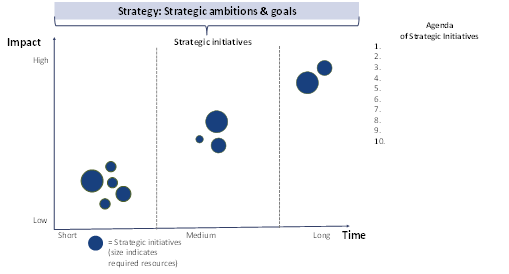
The success of the strategic roadmap depends upon the input, the identified & selected strategic initiatives/projects.
In an earlier article the 3 horizons model (Steve Coley, McKinsey, 2009) was discussed to be able to map & differentiate the short (extend & defend current business), medium (build emerging business and long term (create viable options) strategic initiatives.
3 horizons framework *
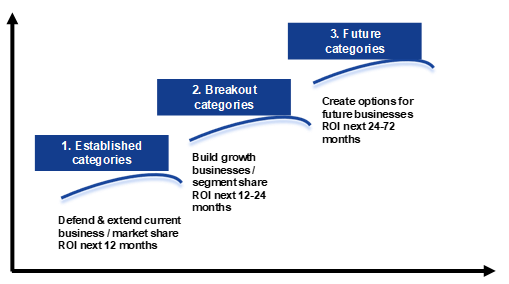
Still, the different horizons need to contain value- adding initiatives. One way to identify these initiatives is to apply the so called 10-types of innovation framework (Doblin).
10 types of innovation framework **
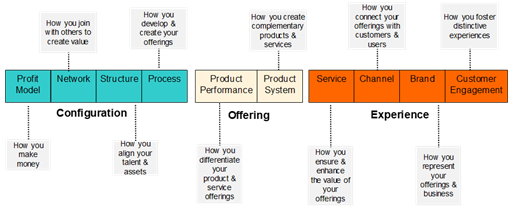
One of the key elements of this framework is to not just focus on products as an area of innovation but to look at the complete value chain of a service and various types of innovation. A big advantage of doing is to identify initiatives which are less easy to copy by competitors (which is often the case with product innovation) and thus sustaining a longer term competitive advantage.
The 10 types of innovations throughout the value chain are organised around 3 main areas. At the left the internal areas are detailed, in the middle the product areas and at the right the external areas which are touching clients.
- Configuration
- How is the organization organized and aims to make a profit?
- Offering
- How is the product organized & set-up?
- Experience
- How does the organization interact with customer (s)?
By following this framework of looking throughout the complete value chain a broader range of types of innovation can be identified (as opposed to just looking at product/technology innovation). As a consequence, by constructing this systematical innovation a higher added value can be reached versus identifying innovation initiatives on a stand-alone basis.
Conclusions:
By combining the two methods innovation can be structured via the 3 horizons AND throughout the value chain. A high impact strategic roadmap containing significant added value can be constructed.
By integrating innovation in this manner into the strategic roadmap, more creativity and diversification can be reached, creating long term value.
Closing remarks:
Key to the overall management of the strategic roadmap is to be agile: regularly revisit the roadmap, compare versus the external & internal situation and adjust the roadmap when deemed necessary.
Looking forward to discuss your thoughts & ideas.
T. Lens