
Scenario planning can help you strategize and reduce uncertainty as you move forward
There is no doubt about that we are living in turbulent and volatile times. There are significant ongoing developments such as geo-political tensions, climate change, increasing inequality, rising energy prices, technological developments….how to strategize during these times?
The coming weeks I will post on the topic of scenario development during turbulent times. I will use as much as possible the impact investment industry as an example.
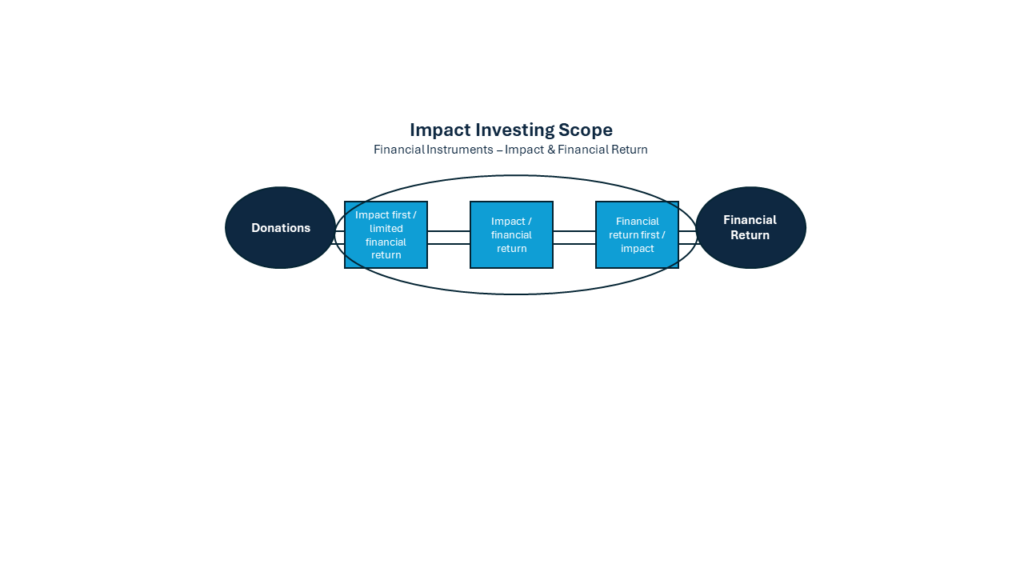
Strategic resilience…. doing noting is not an option.
The buzz word at the moment is how to be resilient to these times of constant change. Scenario development and adaptive strategizing can help prepare organizations for these constant changes and contribute to reducing fear for the unknown and uncertainty.
My personal way of dealing with this situation is to be optimistic and be pro-active in responding and acting to these big trends & developments. Look for the opportunities and act upon them to create impact. I also see very different reactions and behaviours, such as anxiety, fear, freezing up and not responding anymore…somebody told me the other that the they are totally fed up with all these changes, when are we going back to normal, can I influence these big developments? Well, my view is that we will not go back to normal, change is here to stay and its a matter how you prepare and respond to it. One thing the current world in which we are living makes very clear ..taking in account the external environment before you even start developing a strategy is crucial. I am aware that there is only so much which we can influence in our environment but doing nothing is not really an option if you ask me.
Adaptive & dynamic strategizing through scenario planning.
The current world situation makes it almost mandatory to organize your strategy process in such a way that you take stock of your external surroundings in a structural manner. This is where scenario planning comes into play….not once every 4-5 years as part of the usual strategy update but on an ongoing basis. Based upon this input you can determine and decide if you need to adjust or continue what you are doing. Embed it in your organization and use it in your departments and teams.
Don’t fall in the trap of not doing scenario planning on a rolling basis because it seems to be a lot of work and comes at a cost. The cost of not doing it is way higher. Scenario planning can reduce anxiety and fear and avoids (as much as possible) being caught off guard and become paralysed by sudden shocks and the related abundance or information coming at you. Governance is foresight we like to say in the Netherlands.
Plausibility and embracing uncertainty
In this article I look at the Oxford scenario planning approach which is based on plausibility (what can possibly happen). This method aims to recognize the part of uncertainty that is unpredictable. By actively exploring the sources of the turbulence and uncertainty, the goal is to iteratively and interactively generate new insights to help reperceive circumstances. This method doesn’t aim to try to estimate the probability of a scenario. This method takes in account that there is uncertainty involved, we don’t know exactly what will happen tomorrow and that’s ok. Thinking in risks and probabilities will not enable you to think beyond what we already know. Push the boundaries of your current thinking, identify so called blind spots and go beyond what is already out there. By doing this true innovations and competitive advantage can be created.
Step 1 – Scenario Planning: Distil key drivers and try to identify the uncertainties
Collect the information which you believe will influence your environment/organization in the future. From this information you can distil the key driving forces for you industry, sector or topic. Good to know; there is no right or wrong, be open and creative.
It starts with, where do you get your information from? Which sources of information do you use, e.g. which books do you read, which podcasts do you listen to, are you using creative artists as input? There is no guideline for this except that it is key to have an open mind and creative approach. If you stick to reading/watching the same sources as anybody else there is a high chance that you will not really distinctive in the end of the process. What is important is that you challenge yourselves to go beyond what is usual and embrace uncertainty. Identifying driving forces which lead to a future which you are not yet aware of is what you try to do. Widening your thinking and getting new perspectives is the goal.
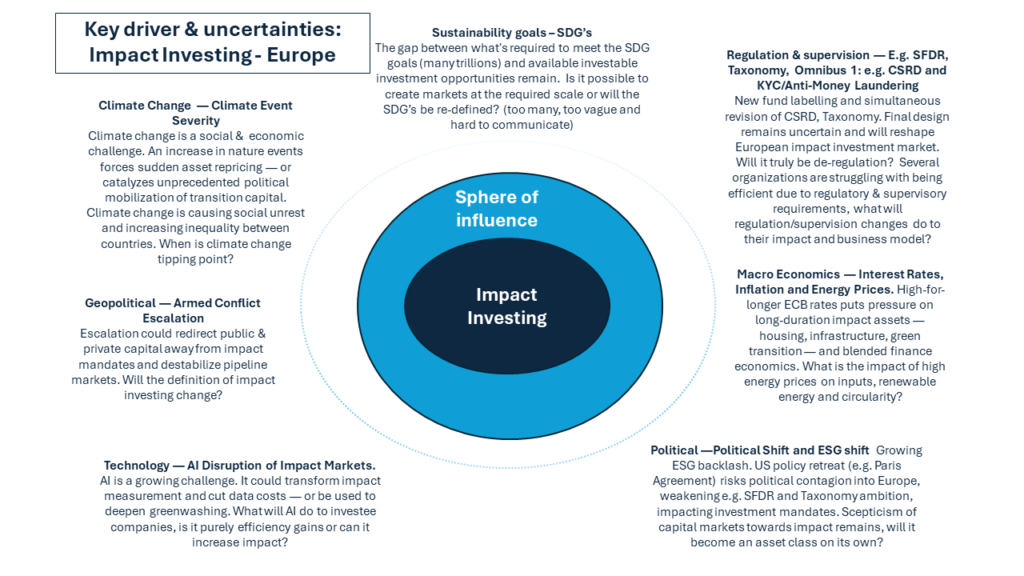
Below I identified the key drivers and associated uncertainties (2) for the European Impact Investment sector. It’s a good start.
At the same time, I am asking myself the question where are my blind spots, what do I miss in this overview, which resources should I have a look at which not everybody else is looking at? What are your thoughts, what is missing, where are the uncertainties? Your input is much appreciated!
Next article: Deeper dive into uncertainties and possible direction. Stay tuned!
1: MIT Sloan Management review, Using Scenario Planning to Reshape Strategy, Rafael Ramírez, Steve Churchhouse, Alejandra Palermo, and Jonas Hoffmann, June 13, 2017
2 Dominic Heil, London Business School, Course: Scenario Planning for Strategic Resilience
This article is written by StratStore, Taco Lens.