
These volatile and turbulent times require even more emphasis on innovation in your business strategy. From creative destruction to jumping on S curves. Enjoy the read.
StratStore November 2025
🔄 Creative Destruction, S-Curves & Why Innovation Is No Longer Optional
With the recent Nobel Prize announcements, Joseph Schumpeter’s concept of creative destruction has been getting renewed attention. The idea is simple but powerful: innovation is essential for countries and organizations to stay competitive. Without it, economic sustainability and prosperity inevitably decline.
Yet whenever the term destruction enters the conversation, people often react with concern. Destruction of what? And why?
The answer becomes clearer when we translate macroeconomic theory into practical business strategy.
📈 From Economic Theory to Strategy: The Power of the S-Curve
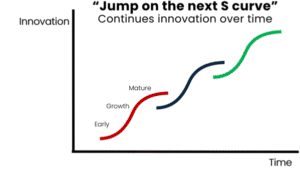
One of the most useful tools to connect Schumpeter’s theory to real-world decisions is the S-curve, commonly used in innovation and business strategy. It illustrates how products, technologies, and even entire industries move through phases: emergence, growth, maturity, and eventually decline.
To thrive, organizations must continually position themselves to jump to the next S-curve before the current one matures.
We’ve all seen what happens when they don’t:
- Kodak failed to embrace digital photography.
- Nokia and BlackBerry underestimated the smartphone revolution.
- Today, fossil fuel companies that delay a full transition to renewables—or European carmakers slow to match EV disruptors—face similar risks.
The lesson is clear: staying on the same curve for too long is not a viable strategy.
🚀 Strategy Choices: Early, Growth, or Mature?
Each phase of the S-curve brings both opportunities and trade-offs:
1️⃣ Early Stage / Innovator
Being an early mover can be incredibly rewarding:
- Low competition
- High margins
- Ability to shape the market
But it requires high R&D investment and the willingness to take significant risks.
2️⃣ Growth Stage / Fast Follower
Arriving a little later can be smart—if you leverage existing strengths such as:
- Strong brand
- Wide distribution
- Loyal customer base
- Existing patents
This can allow companies to scale rapidly without the highest upfront risk.
3️⃣ Mature Stage
Here margins shrink, competition rises, and scale becomes essential. Staying too long in this phase without preparing for the next curve often leads to decline.
⏳ Shorter Life Cycles = Shorter S-Curves
When Schumpeter first introduced his ideas, product life cycles were far longer. Kodak dominated photography for decades before digital technology emerged. But digital cameras were disrupted much faster by smartphones with built-in cameras.
Today, S-curves are increasingly short. This makes continuous trend monitoring, innovation, and adaptability indispensable.
Organizations that fail to anticipate the next curve risk being locked into low-margin maturity—without the capacity to pivot.
🌱 Building a Culture of Innovation & Scaling
Success now depends on a built-in commitment to innovation:
- Staying alert to technological, societal, and geopolitical shifts (e.g., climate change)
- Aligning innovation with mission, vision, and organizational DNA
- Using frameworks like the Three Horizons Framework (McKinsey) to map the future
- Ensuring the board is genuinely committed to long-term investment—even before returns are visible
Innovation requires courage, patience, and a willingness to take calculated risks.
🎯 Final Thoughts
Creative destruction isn’t about “destroying” for the sake of it. It’s about renewal, relevance, and sustainability.
Organizations that continuously innovate—and prepare for the next S-curve—are the ones that will create value, remain competitive, and thrive in an increasingly dynamic world.
PS: These reflections are my personal perspective, shaped by key trends, developments, and the insights I’ve gained through academic study and practical work experience. My mission is to translate complex concepts and theories into clear, actionable insights—and to help make challenging topics more accessible for everyone.