
Scenario planning can help you strategize and reduce uncertainty as you move forward
There is no doubt about that we are living in turbulent and volatile times. There are significant ongoing developments such as geo-political tensions, climate change, increasing inequality, rising energy prices, technological developments….how to strategize during these times? The buzz word at the moment is how to be resilient to these times of constant change and how to increase adaptability. Scenario development is a way to increase your organizations adaptability in strategic thinking. This creates an enormous competitive advantage.
The coming weeks I will post on the topic of scenario development during turbulent times. I will use as much as possible the impact investment industry as an example.
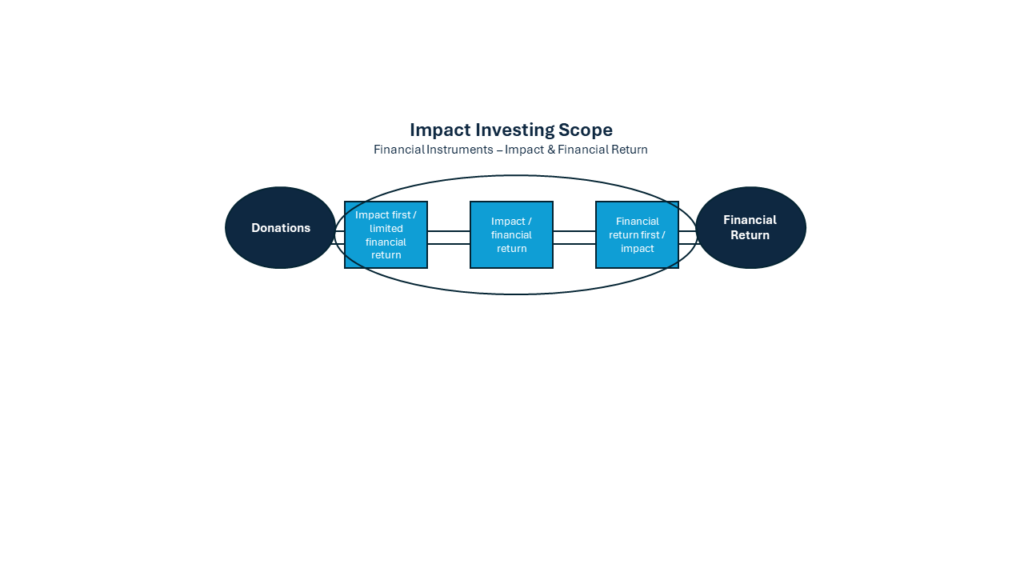
From key drivers & uncertainties to scenarios.
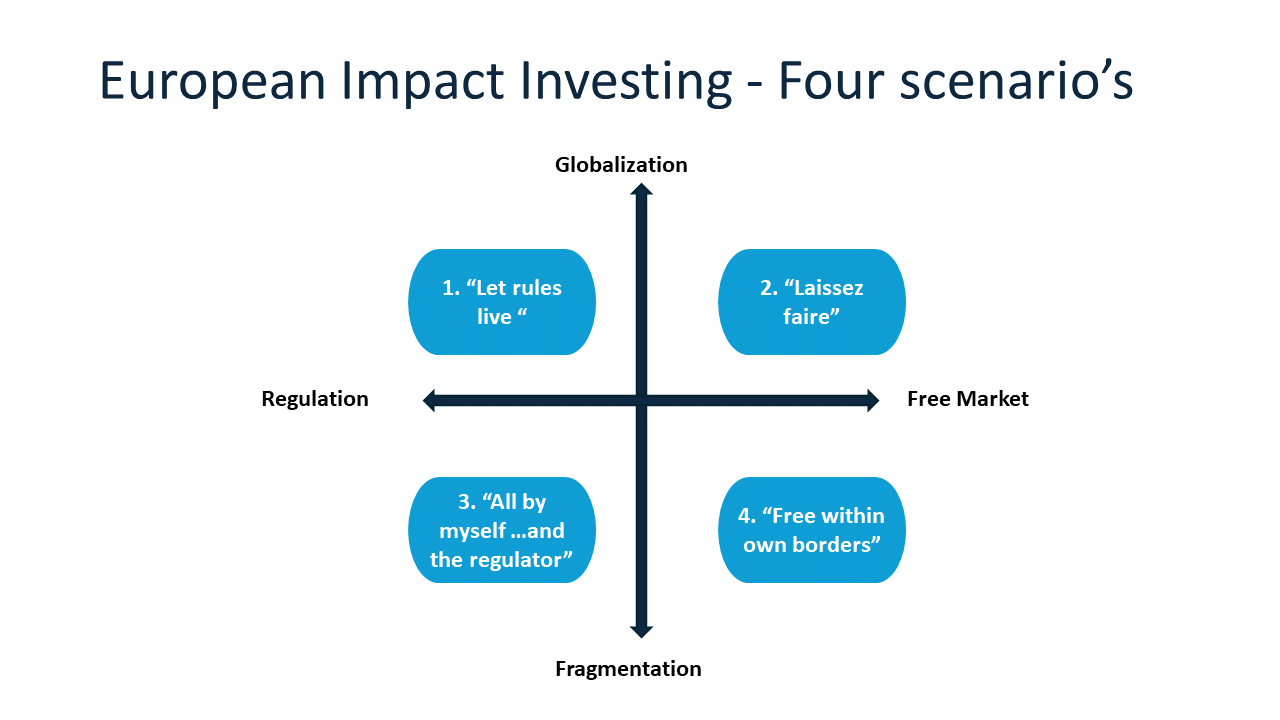
It the earlier article I talked about identifying the key drivers & uncertainties for the European Impact investment arena. The next step is to distil out of these the main ones which you believe will have the highest impact and are surrounded with the highest uncertainty. In this case I selected globalization versus fragmentation as one key driver following geo-political developments and heavy regulation versus a relatively light regulatory situation as the other main driver.
The reason for selecting two scenario’s is because we can map them into a grid which then identifies four scenarios.
The four identified scenarios are labelled as following:
- “Let rules live” – Full focus on globalization & high regulatory intervention
- “Laissez faire” – Full focus on globalization & limited regulatory intervention
- “All by myself….and the regulator” – Country focus & high regulatory intervention
- “Free within own borders” – Country focus & limited regulatory interventions
Below find attached an example for the European Impact Investing arena.
Obviously, you can play around with different key drivers to come to the two which you believe are most valuable to further investigate. It is important to select key driver which are not directly correlated which each other otherwise you will end up with most probably two instead of four scenarios which will not challenge you sufficiently in you strategic thinking. (as an example, inflation and interest rates, since we all know that these are highly correlated and thus will not lead to sufficiently challenging scenario’s)
Within these scenario’s you need to identify identical sub topics to further investigate/elaborate upon to describe what happens with each of these scenarios. For example:
- Geo-political (if this in itself is not a key driver)
- Social
- Economic
- Political
- Legislation
- Climate change/sustainability
- Technology
- Others
By describing for each of the scenario’s the foreseen situation you are starting to go towards a narrative.
Scenarios are narratives – engaging your audience and challenge them is key
Scenarios are a narrative of how the future might unfold (1). As mentioned before, its not a prediction, its a story. They are meant to challenge your assumptions versus the current strategic path you are on. In this way you come to new insights and the strategic priorities. The power lies in how it makes you think. It brings us back to the first article. There are four important criteria for a solid scenario:
- Plausibility; it should possibly happen is partly already started; if its too far off then the chance is high that your audience will not look at it seriously / doesn’t feel engaged
- Distinctive scenario’s; Sufficiently large differences between the scenario’s; the scenarios in itself should be possible
- Relevance; addressing key challenges which are relevant for the audience your are talking to. IF one of your scenario’s will happen the audience should see the relevance towards its strategy and trigger strategic reactions.
- Challenging & uncomfortable; trigger stretched thinking and challenge your current assumptions
There are also some key requirements: avoid overcomplexity, stakeholder involvement and involve people from different topics/areas (avoid not invented here syndrome), ensure everybody understands the purpose of the exercise, treat is as a forecast, not a prediction (to avoid one is chosen because of the preciseness of the predictability).
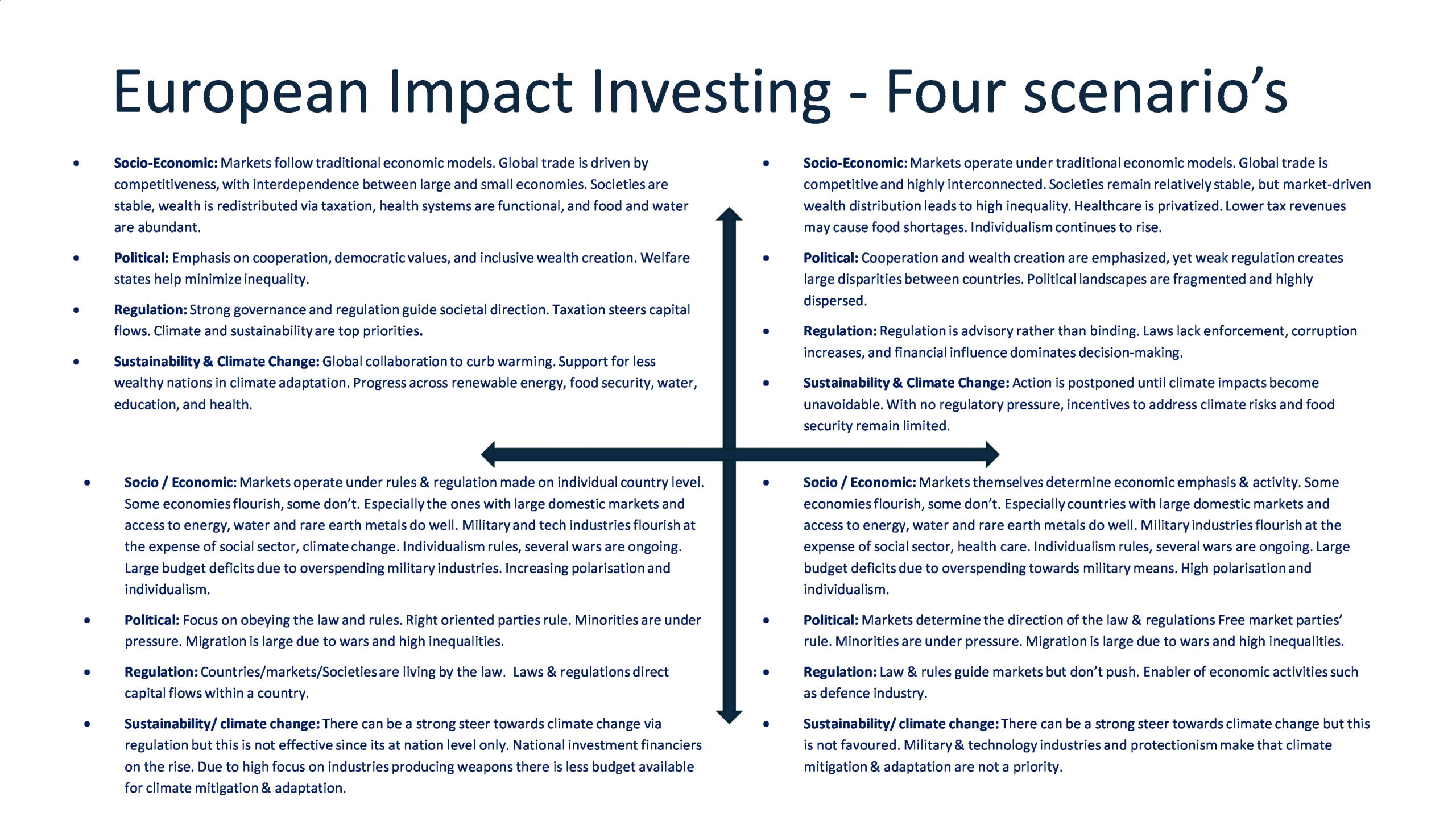
Next time: Strategic response and further enhancement of the scenario’s into stories.
1 Donal Crilly, London Business School, Course: Scenario Planning for Strategic Resilience
This article is written by StratStore, Taco Lens.